Florence: Welcome back. Today we are doing something slightly different: not a buying guide, but a calendar. Ramadan 2027, and the exact week a boutique has to place its order.
Oliver: Which is the part everyone gets wrong. They plan the collection and forget the clock.
Kaan: The clock is the collection. Ask anyone who has sold from sealed cartons in February.
Florence: So, the dates first. Kaan, what are we working with?
Kaan: Ramadan 1448 begins on Monday the eighth of February 2027. Eid al-Fitr is the ninth of March, or the tenth, depending on the moon sighting where your customers live.
Oliver: Ninety-six days from now. That is - wait, really? That soon?
Kaan: It always feels soon. And for planning it does not matter whether Ramadan starts on the eighth or the ninth. What matters is when the shelf is full.
Florence: Right. And the shelf date is not February. Modest-wear shoppers start three to five weeks before Ramadan. So the stock has to be in the shop by the second week of January.
Oliver: And that is where my first Ramadan went wrong, years ago. I ordered in January, everything looked fine on paper, and then the pallet sat at customs for nine days.
Florence: Nine days in January is the whole pre-season.
Oliver: It was. I opened the season with four styles and a lot of empty rail.
Kaan: A ready-stock order from Türkiye takes four to six weeks door to door. Production in days, road freight five to seven business days to the UK, air one to two. Groupage adds two or three days at the hub.
Florence: So if I order in the first week of December, I have a buffer.
Kaan: You have two weeks of buffer. Order in January and every delay comes straight out of your best trading days.
Oliver: And if you want your own label? Then the clock is completely different.
Kaan: Made to order is three to four months from an approved sample. Our own private label programme runs ninety to a hundred and twenty days before first delivery, and it starts at three thousand units per style.
Florence: Which is a chain conversation, not a boutique one. So for this season: ready stock, December, done.
Oliver: Right. Now the fun part. What actually goes in the order?
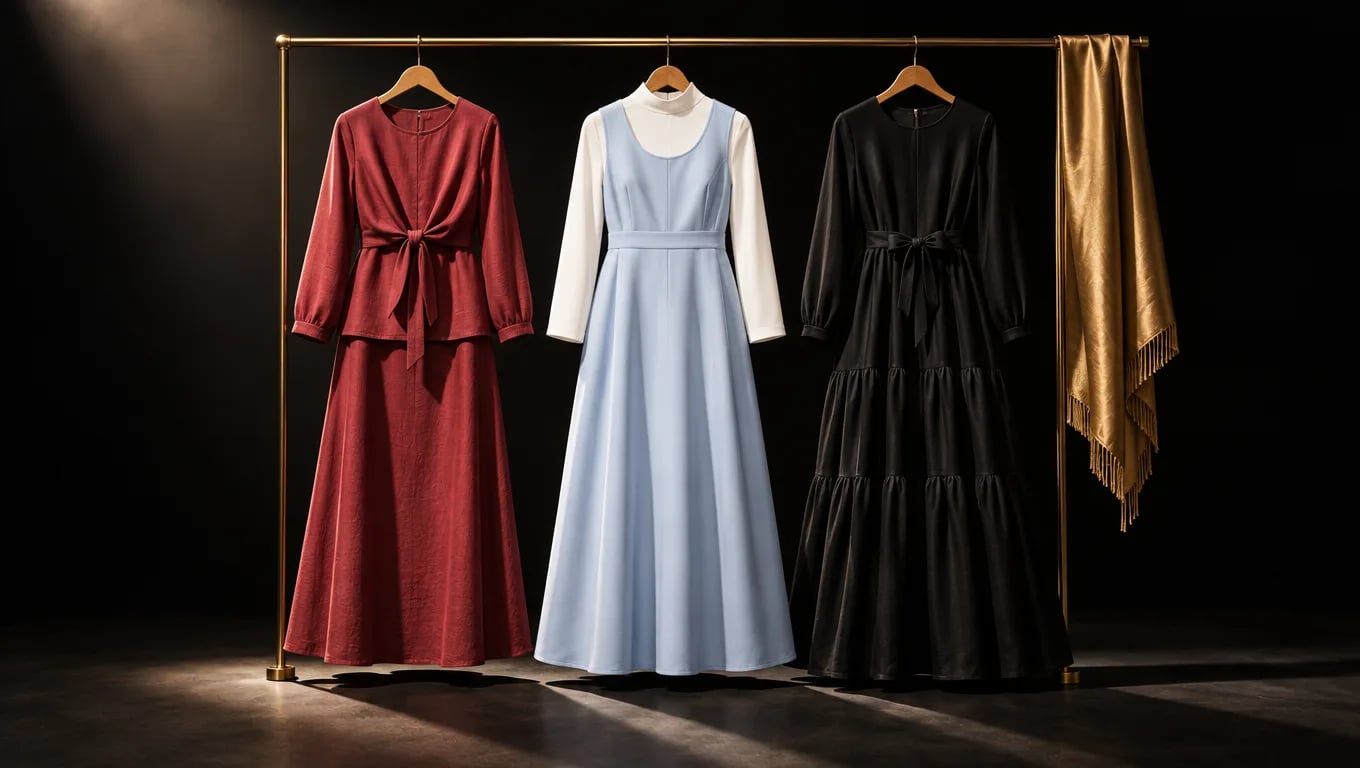
Florence: Five groups. Two-piece modest sets, maxi and midi dresses in a woven or crepe, tunic and jile sets, layering cardigans, and scarves or shawls as the add-on.
Kaan: And three or four colours, deep. Not eight colours, one piece each. A customer who finds her size and her colour buys. A rail of orphans sells nothing.
Oliver: Ah, the rainbow rail. Very beautiful, very expensive.
Florence: How much stock is enough for a first season?
Kaan: Forty to fifty pieces across eight to ten styles. At wholesale that is around a thousand dollars. Then hold back twenty to thirty per cent of the budget.
Oliver: Hold back? Most people spend it all on the first order.
Kaan: And then they cannot reorder the one set that sold out in ten days. January tells you more than any forecast. Keep the money for it.
Florence: Last thing: the season does not end in March. Eid al-Adha is around the sixteenth of May, a smaller occasion order, placed in March once the Ramadan numbers are in.
Kaan: And do not simply repeat the Ramadan order. Same customer, different weather, different price she will pay.
Oliver: So: December order, January shelf, February sell, March reorder for May. That is the whole year in one sentence.
Florence: That is the whole year. The full calendar, with the month by month table, is on our blog. Thanks for listening.
Ramadan 2027 dates are Monday 8 February to about Tuesday 9 March, with Eid al-Fitr on 9 or 10 March depending on the moon sighting in your country. For a boutique, the date that decides the season is not the first day of fasting: it is the week the stock has to be on the shelf. Modest-wear shoppers start buying three to five weeks before Ramadan, so the shelf date is the second week of January 2027, and a wholesale order placed in the first days of December still lands with time to spare. This guide works that calendar backwards, month by month.
Key takeaways
- Ramadan 1448 begins on Monday 8 February 2027; Eid al-Fitr falls on 9 or 10 March 2027.
- Stock needs to be on the shelf by the second week of January, not in February.
- A ready-stock wholesale order takes about four to six weeks door to door from Türkiye; your own label takes three to four months.
- The last comfortable order date for a first Ramadan drop is the first week of December 2026.
- Keep 20 to 30 per cent of the budget for a January reorder: the first two weeks of selling tell you more than any forecast.
Ramadan 1448 AH is expected to begin on Monday 8 February 2027 and end with Eid al-Fitr on Tuesday 9 March 2027, according to the Umm al-Qura calendar used for planning in Saudi Arabia. Some countries will announce 10 March instead, because the start of a lunar month depends on the crescent sighting where you live, and the official date is only confirmed on the evening of 29 Ramadan. The same one-day uncertainty applies at the start: 8 February is the estimate, 9 February is possible.
| Event | Expected date (2027) | What it means for your shop |
|---|---|---|
| Ramadan begins (1 Ramadan 1448) | Monday 8 February | Modest daywear and layering are already selling |
| First ten days | 8 to 17 February | Restock the styles that moved in January |
| Middle ten days | 18 to 27 February | Evening and occasion pieces start to move |
| Last ten days | 28 February to 8 March | Peak gifting and Eid outfit buying |
| Eid al-Fitr (1 Shawwal 1448) | Tuesday 9 March (10 March in some countries) | Outfit sales stop; gifts and children's pieces finish |
| Eid al-Adha (10 Dhu al-Hijjah 1448) | Sunday 16 May | A second, smaller occasion season |
Dates come from the Umm al-Qura calendar tables and are estimates for planning only. Before you print a date on a poster, wait for the announcement from the religious authority in your market.
The modest-fashion market behind these dates is not a niche any more. Muslim consumer spending on modest fashion reached about 347 billion US dollars in 2024, up 6.2 per cent on the year, and is projected to reach 444 billion by 2029, according to the State of the Global Islamic Economy 2025/26 report. Two things follow for a small shop: the competition for the same seasonal window is real, and a supplier who can restock in weeks rather than months is worth more than a slightly lower price per piece.
Ramadan retail has two peaks, not one. The first runs from mid-January to the first days of Ramadan: women refresh their everyday modest wardrobe, so long-sleeve tunics, two-piece sets, maxi dresses and light layers sell. The second peak is the last ten days, when Eid outfits, gifts and children's pieces move, and it is shorter and sharper than the first.
That timing is why an order that arrives in February is late. If the first delivery lands in the second week of January, you have two or three weeks to see what sells before the season starts, and one clean reorder window in early February. If it lands on 8 February, you are selling from sealed cartons and guessing.
Seasonality also stacks with the weather. February in the UK, Germany or the Netherlands is cold, so the Ramadan wardrobe is built in layers: a modest set or maxi dress worn with a knit cardigan, a long coat and a scarf. That is good news for a wholesale order, because a layer sells twice.
Work backwards from the shelf date, not forwards from today.
| When | What to do | Why |
|---|---|---|
| November 2026 | Place the first Ramadan order: modest sets, tunics, maxi dresses, layering knits and scarves | Leaves room for a correction before the season |
| First week of December 2026 | Last comfortable order date for ready stock from Türkiye | Production plus road freight plus customs fits in six to eight weeks |
| January 2027 | Stock lands; merchandise the window; photograph the pieces you will push | Two to three weeks of real sales data before Ramadan |
| Early February 2027 | Reorder the winners in the same size curve; add occasion pieces | The first ten days of Ramadan confirm demand |
| Late February 2027 | Final top-up on Eid outfits and gifts; stop buying daywear | Last-ten-days demand is short and unpredictable |
| March 2027 | Sell through Eid, then plan Eid al-Adha (16 May) | Post-Eid is a markdown period, not a buying period |
The first week of December is a practical deadline rather than a rule. It assumes a supplier holding ready stock, a road or air shipment and a normal customs clearance. A supplier who makes to order, or a shipment by sea, moves that deadline back by weeks.
A Ramadan capsule is narrower than a spring collection, and it repeats the same shapes in a few colours. For a boutique buying Turkish wholesale, five groups cover the season.
Colour runs long in this season. Buy three or four colours deep on the best shape instead of eight colours shallow, because a customer who finds her size and colour buys, and a rail of single pieces in eight shades sells nothing.
Most Turkish wholesale runs in packs, often a pack of five or six pieces across a size curve. Two numbers decide whether the order works: how the pack splits across sizes, and how much of the budget you hold back.
Ask for the size split in writing before you pay. A pack that gives you one small, three medium and one large is a different buy from a flat split, and Ramadan customers in the UK and EU skew larger than the size curve some catalogues assume. If the split is fixed, order two packs and accept that one size will run out first; if it is flexible, ask for a curve closer to 20 per cent small, 50 per cent medium, 30 per cent large.
Then split the budget in three. About half goes on the core shapes you are confident about, a quarter on one or two print or occasion pieces that give the rail a story, and 20 to 30 per cent stays unspent for the January and February reorders. A first order of 1,000 US dollars at wholesale prices buys roughly 40 to 50 pieces across eight to ten styles; that is enough to fill a window and still learn something. The guide to wholesale minimums covers how pack sizes and per-order minimums interact.
Three clocks run at once: production, freight and customs. Ready stock skips the first one.
Road freight from Istanbul to the UK takes five to seven business days for a full truck, and air cargo one to two days; Germany, France and the Netherlands are a day or two quicker by road, according to 2026 transit-time tables from a Turkish freight forwarder. Groupage, where your pallet shares a trailer, adds two to four days at the hub. Customs clearance for textiles into the UK or EU is normally a day or two when the paperwork is right, and a week or more when it is not, so the commercial invoice, the packing list and the origin declaration matter as much as the freight booking.
Made-to-order is the slow clock. Sampling, bulk production and finishing run 90 to 120 days before first delivery in our own private label programme, which starts at 3,000 units per style in six colourways; that is a programme for chains, not for a first Ramadan season. A small boutique with its own label should plan on three to four months from approved sample to delivery, which means a Ramadan 2027 own-label run had to be sampled in autumn 2026.
For a shop buying ready stock, the arithmetic is simple: four to six weeks from order to shelf, plus a buffer. Order in the first week of December and a delay of a week costs nothing. Order in January and a delay of a week costs the first ten days of the season.
Eid al-Adha falls around Sunday 16 May 2027, ten weeks after Eid al-Fitr. It is a family and gifting occasion more than a fashion one: children's pieces, comfortable daywear, and modest sets in lighter fabrics for warmer weather. Order it in March, after the Ramadan sell-through is clear, and use what you learned: the shapes that sold, the size that ran out, the colours that stayed on the rail. It is also the natural moment to move winter stock out and bring in the spring modest range, so the two orders share one freight booking and one customs entry.
Do not repeat the Ramadan order for Eid al-Adha. The customer is the same, but the weather, the occasion and the price she will pay are different.
Ramadan 1448 AH is expected to begin on Monday 8 February 2027 and end on about 8 March, with Eid al-Fitr on 9 or 10 March 2027. The exact start depends on the crescent sighting in each country and is confirmed the evening before. For buying decisions, treat 8 February as the planning date and 9 February as a possible one-day shift.
Place the first order by the first week of December 2026 so it lands in the second week of January, three to five weeks before shoppers start buying. A ready-stock order from Türkiye takes about four to six weeks door to door. Buying in January still works if nothing goes wrong, but it leaves no room for a customs delay or a reorder before the season starts.
Suppliers holding ready stock dispatch in days, and the shipment itself takes five to seven business days by road to the UK or one to two days by air, plus customs. Production is the variable: made-to-order runs take three to four months from approved sample, and a private label programme with its own fabric and labels can take longer.
Long-sleeve two-piece modest sets, maxi and midi dresses in woven fabrics, tunic and jile sets, layering cardigans, and scarves or shawls as add-ons. Dark solids sell through the month; one gold, burgundy or deep green piece per rail carries the Eid window. Children's pieces and gifts move in the last ten days.
Plan the Ramadan capsule around 40 to 50 pieces across eight to ten styles for a first season, and keep 20 to 30 per cent of the budget for reorders in January and February. Buy deep in three or four colours on the best shapes rather than shallow across many, and place the Eid al-Adha order in March once the Ramadan sell-through is clear.
If you are building the capsule now, the pieces that carry a Ramadan rail are the half-button linen-look two-piece modest set, the double crepe jile set and a long-sleeved tiered maxi dress that layers under a coat in February. For the wider season plan, the holiday boutique stock guide shows the same working-backwards method for Q4.